


Sweeping robots are the fastest-growing segment in the smart home cleaning appliance market. As consumers’ demand for automated and intelligent home cleaning keeps rising, product functions have expanded significantly. The offerings have evolved from simple sweeping to integrated sweeping & mopping, automatic mop washing, auto dust collection, automatic water inlet & drainage, and robotic-arm-assisted cleaning. Accordingly, robots require a greater number of sensing components with higher precision.
According to market data from Tenxer Labs, the global sweeping robot market reached USD 11.1 billion in 2025, and is projected to grow to USD 35.6 billion by 2035, representing a compound annual growth rate (CAGR) of approximately 12.3% over the decade, with substantial room for market expansion.
Within China, sweeping robots have become a core category of smart home devices. China’s domestic sales volume stood at roughly 6–7 million units in 2024, while global shipments were around 25–30 million units. Based on an estimated average consumption of ~10 Hall sensors per unit, the sweeping robot industry consumes roughly 300 million Hall sensor chips worldwide each year, reflecting considerable market demand.
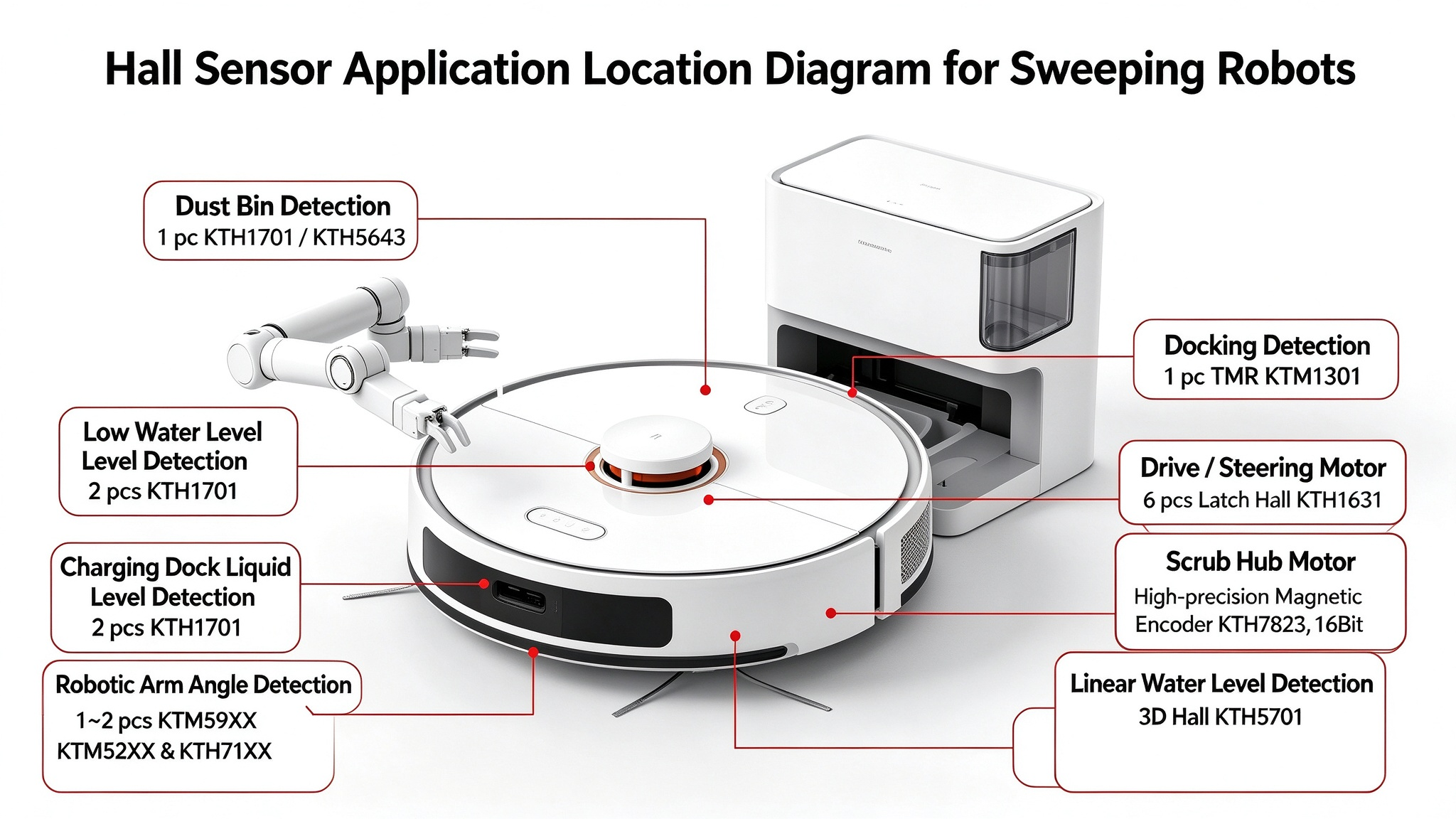
Junmin Technology & CONTEK Microelectronics Hall sensor portfolio fully covers key subsystems of sweeping robots, including the main unit, charging dock, robotic arm and stair-climbing legs. We deliver a one-stop sensing solution for position detection, liquid level monitoring, motor drive and high-precision angle encoding.
Typical on-board application points and component allocation are listed below:
表格
| Subsystem | Application Function | Recommended Devices & Quantity |
|---|---|---|
| Main Unit System | Water level / dust bin / motor / hub motor detection | Omnipolar Hall, Linear Hall, 3D Hall, High-precision Magnetic Encoder |
| Charging Dock System | Liquid level detection, docking detection | Omnipolar Hall KTH1701, Omnipolar TMR KTM1301 |
| Robotic Arm / Stair-Climbing Legs | Angle detection | Ultra-high-precision magnetic encoder KTM59XX / KTM52XX & KTH71XX |
Table 1: Summary of Hall Sensor Application Points for Sweeping Robots
The robot main unit integrates core functions such as sweeping, vacuuming, washing & mopping, and locomotion. Hall sensors undertake critical tasks including position detection, status judgment and motor control.
For low water level warning in clean water tanks, 2 units of omnipolar Hall sensor KTH1701 series are recommended. Featuring high sensitivity and low power consumption, this series stably tracks float position changes and triggers low-water alerts in time, preventing degraded cleaning performance caused by dry-running.
Proper installation of the dust bin directly impacts suction performance and operational safety. This position can use 1 omnipolar Hall KTH1701 or 1 linear Hall KTH5643 for reliable detection and feedback of the dust bin open/closed status.
The drive and steering motors of robot wheels require accurate position and speed feedback. 4 latch Hall sensors KTH1631 series are recommended for rotor position sensing. They provide precise signals for motor commutation and speed regulation, ensuring smooth travel and accurate steering.
For high-end models requiring real-time continuous water level monitoring, the 3D Hall sensor KTH5701 with linear output is preferred. Unlike traditional on-off detection, linear output enables continuous water level measurement, supporting refined water control and improved user experience.
Hub motors for floor scrubbing require high-precision angle feedback for accurate speed and torque control. The high-precision magnetic encoder KTH7823 is recommended, supporting on-axis and off-axis mounting. It delivers up to 16-bit resolution and supports multiple interfaces including SPI, SSI, UVW, PWM and ABZ.
With a single-pole-pair magnet setup, the end-of-shaft detection accuracy reaches ±0.35°, satisfying strict high-precision position feedback requirements for floor scrubber hub motors.
Acting as the “supply station” for sweeping robots, the charging dock manages clean water refilling, sewage collection and automatic recharging. Multiple Hall sensors are deployed for status perception.
For liquid level monitoring of clean and sewage tanks on the charging dock, 2 omnipolar Hall KTH1701 chips are recommended. They reliably identify high/low water levels and work with the main controller to enable auto water refilling and sewage full alerts.
Accurate docking of the robot into the charging dock is a prerequisite for normal recharging and auto water exchange. 1 omnipolar TMR sensor KTM1301 series is recommended. Leveraging TMR technology’s advantages of high sensitivity and low power consumption, it precisely confirms successful robot docking.
As high-end sweeping robots keep upgrading, auxiliary cleaning robotic arms and stair-crossing capability have become key differentiators. These novel motion mechanisms demand superior angle detection accuracy.
For angle sensing of robotic arm joints or stair-climbing legs, 1–2 ultra-high-precision magnetic encoder chips are recommended. Available options include the KTM59XX series, or a combined KTM52XX + KTH71XX solution. These devices deliver high-accuracy angle measurement, supplying dependable position feedback for robotic motion control and gait adjustment, enabling advanced cleaning actions and obstacle-crossing for premium models.
Supported by a comprehensive product lineup and outstanding performance, Hall sensor chips from Junmin Technology & CONTEK Microelectronics have been adopted in volume by many leading sweeping robot manufacturers at home and abroad. Key customers include:
Leading domestic brands: Ecovacs, Roborock, Dreame, Narwal
Home appliance & internet brands: Xiaomi/Mijia, Haier, Midea, Uoni
Global & export-focused brands: iRobot, Chinese OEMs, Anker eufy
The sweeping robot market is on a rapid growth trajectory. Basic models use several Hall sensors, while premium units can require more than ten. Adoption of robotic arms and stair-climbing functions will further raise per-unit sensor consumption. Based on annual global shipments of 25–30 million units and an average of ~10 Hall chips per robot, annual global demand reaches roughly 300 million pieces, representing huge market potential.
The full-set Hall sensor solution for sweeping robots from Junmin Technology & CONTEK Microelectronics features these core strengths:
Complete product portfolio: Omnipolar Hall, Linear Hall, 3D Hall, Latch Hall, TMR sensors and high-precision magnetic encoders
Wide application coverage: Covers all core subsystems, from basic water / dust bin detection to high-precision motor angle encoding
Superior performance specs: High-precision encoders with 16-bit resolution, ±0.35° accuracy for single-pole-pair end-of-shaft measurement
Proven customer validation: Mass production supply to mainstream global sweeping robot brands with stable large-volume delivery capacity
Going forward, as sweeping robots grow smarter and gain richer functions, Junmin Technology together with CONTEK Microelectronics will continue to deepen our presence in smart home sensing. We will deliver higher-performance, diversified Hall sensor chips to help customers build smarter, more reliable sweeping robots.


 0755-2810 2601
 +86 181 2402 2785
 marketing@junmintech.cn


